2026.05.24(일) 17:02
 교육타임즈 지면신문








|
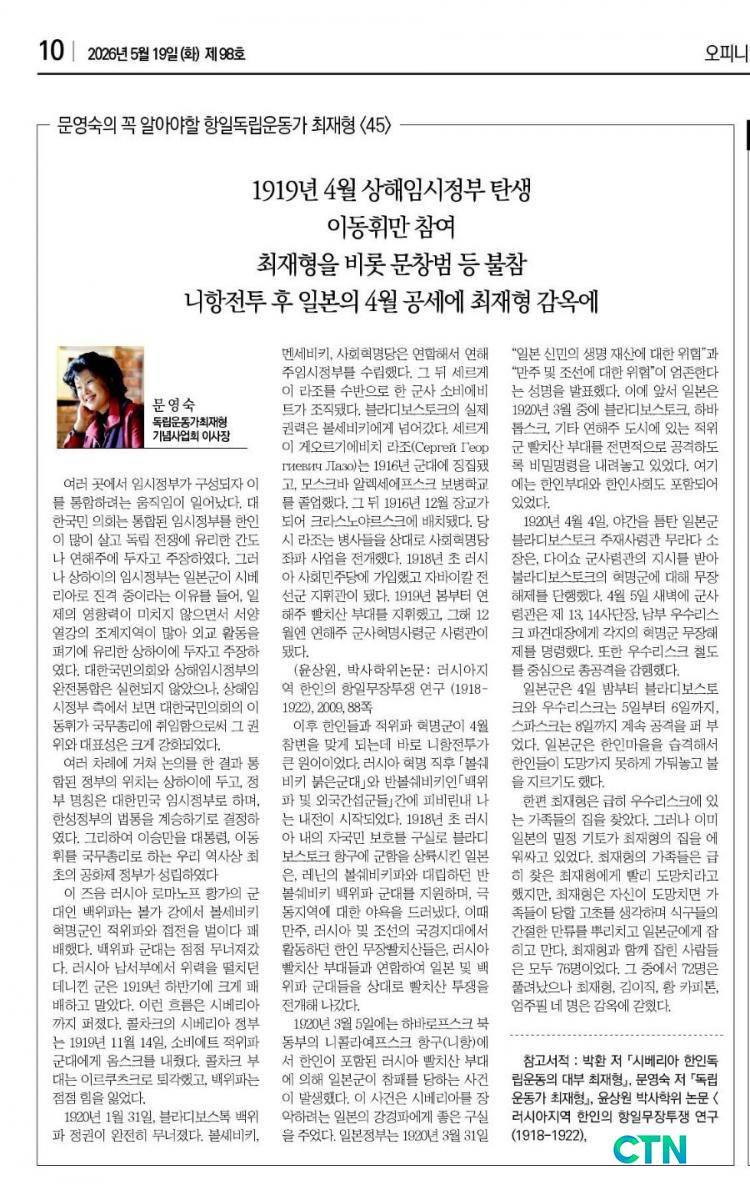
여러 차례에 거쳐 논의를 한 결과 통합된 정부의 위치는 상하이에 두고, 정부 명칭은 대한민국 임시정부로 하며, 한성정부의 법통을 계승하기로 결정하였다. 그리하여 이승만을 대통령, 이동휘를 국무총리로 하는 우리 역사상 최초의 공화제 정부가 성립하였다
이 즈음 러시아 로마노프 황가의 군대인 백위파는 볼가 강에서 볼세비키 혁명군인 적위파와 접전을 벌이다 패배했다. 백위파 군대는 점점 무너져갔다. 러시아 남서부에서 위력을 떨치던 데니낀 군은 1919년 하반기에 크게 패배하고 말았다. 이런 흐름은 시베리아까지 퍼졌다. 콜차크의 시베리아 정부는 1919년 11월 14일, 소비에트 적위파 군대에게 옴스크를 내줬다. 콜차크 부대는 이르쿠츠크로 퇴각했고, 백위파는 점점 힘을 잃었다.
1920년 1월 31일, 블라디보스톡 백위파 정권이 완전히 무너졌다. 볼셰비키, 멘세비키, 사회혁명당은 연합해서 연해주임시정부를 수립했다. 그 뒤 세르게이 라조를 수반으로 한 군사 소비에비트가 조직됐다. 블라디보스토크의 실제권력은 볼세비키에게 넘어갔다. 세르게이 게오르기에비치 라조(Сергей Георгиевич Лазо)는 1916년 군대에 징집됐고, 모스크바 알렉세에프스크 보병학교를 졸업했다. 그 뒤 1916년 12월 장교가 되어 크라스노야르스크에 배치됐다. 당시 라조는 병사들을 상대로 사회혁명당 좌파 사업을 전개했다. 1918년 초 러시아 사회민주당에 가입했고 자바이칼 전선군 지휘관이 됐다. 1919년 봄부터 연해주 빨치산 부대를 지휘했고, 그해 12월엔 연해주 군사혁명사령군 사령관이 됐다.
(윤상원, 박사학위논문: 러시아지역 한인의 항일무장투쟁 연구 (1918-1922), 2009, 88쪽
이후 한인들과 적위파 혁명군이 4월참변을 맞게 되는데 바로 니항전투가 큰 원이이었다. 러시아 혁명 직후 「볼쉐비키 붉은군대」와 반볼쉐비키인「백위파 및 외국간섭군들」간에 피비린내 나는 내전이 시작되었다. 1918년 초 러시아 내의 자국민 보호를 구실로 블라디보스토크 항구에 군함을 상륙시킨 일본은, 레닌의 볼쉐비키파와 대립하던 반볼쉐비키 백위파 군대를 지원하며, 극동지역에 대한 야욕을 드러냈다. 이때 만주, 러시아 및 조선의 국경지대에서 활동하던 한인 무장빨치산들은, 러시아 빨치산 부대들과 연합하여 일본 및 백위파 군대들을 상대로 빨치산 투쟁을 전개해 나갔다.
1920년 3월 5일에는 하바로프스크 북동부의 니콜라예프스크 항구(니항)에서 한인이 포함된 러시아 빨치산 부대에 의해 일본군이 참패를 당하는 사건이 발생했다.
이 사건은 시베리아를 장악하려는 일본의 강경파에게 좋은 구실을 주었다. 일본정부는 1920년 3월 31일 “일본 신민의 생명 재산에 대한 위협”과 “만주 및 조선에 대한 위협”이 엄존한다는 성명을 발표했다. 이에 앞서 일본은 1920년 3월 중에 블라디보스토크, 하바롭스크, 기타 연해주 도시에 있는 적위군 빨치산 부대를 전면적으로 공격하도록 비밀명령을 내려놓고 있었다. 여기에는 한인부대와 한인사회도 포함되어 있었다.
1920년 4월 4일, 야간을 틈탄 일본군 블라디보스토크 주재사령관 무라다 소장은, 다이쇼 군사령관의 지시를 받아 불라디보스토크의 혁명군에 대해 무장해제를 단행했다. 4월 5일 새벽에 군사령관은 제 13, 14사단장, 남부 우수리스크 파견대장에게 각지의 혁명군 무장해제를 명령했다. 또한 우수리스크 철도를 중심으로 총공격을 감행했다.
일본군은 4일 밤부터 블라디보스토크와 우수리스크는 5일부터 6일까지, 스파스크는 8일까지 계속 공격을 퍼 부었다. 일본군은 한인마을을 습격해서 한인들이 도망가지 못하게 가둬놓고 불을 지르기도 했다.
한편 최재형은 급히 우수리스크에 있는 가족들의 집을 찾았다. 그러나 이미 일본의 밀정 기토가 최재형의 집을 에워싸고 있었다. 최재형의 가족들은 급히 찾은 최재형에게 빨리 도망치라고 했지만, 최재형은 자신이 도망치면 가족들이 당할 고초를 생각하며 식구들의 간절한 만류를 뿌리치고 일본군에게 잡히고 만다. 최재형과 함께 잡힌 사람들은 모두 76명이었다. 그 중에서 72명은 풀려났으나 최재형, 김이직, 황 카피톤, 엄주필 네 명은 감옥에 갇혔다.
참고서적 : 박환 저 『시베리아 한인독립운동의 대부 최재형』, 문영숙 저 『독립운동가 최재형』, 윤상원 박사학위 논문 <러시아지역 한인의 항일무장투쟁 연구 (1918-1922),
[영문번역-ai]
hoi Jae-hyung: The Anti-Japanese Independence Activist You Must Know] The Birth of the Shanghai Provisional Government in April 1919
Moon Young-sook, Chairperson of the Choi Jae-hyung Memorial Association
Only Yi Dong-hwi participated.
Choi Jae-hyung, Moon Chang-bum, and others did not participate.
Following the Battle of Nihang (Nikolayevsk Incident), Choi Jae-hyung was imprisoned during the Japanese April Offensive.
As provisional governments were formed in various regions, movements emerged to integrate them. The Korean National Council (Daehan Gukmin Uihwe) argued that the unified provisional government should be established in Jiandao (Gando) or the Maritime Province (Yeonhaiju), where many Koreans resided and conditions were favorable for conducting a war of independence. However, the Provisional Government in Shanghai argued for Shanghai, citing that the Japanese military was advancing into Siberia. They emphasized that Shanghai, with its numerous concessions of Western powers, was beyond the reach of Japanese influence and thus advantageous for diplomatic activities. Although a complete integration between the Korean National Council and the Shanghai Provisional Government was not realized, the authority and representativeness of the Shanghai Provisional Government were significantly strengthened when Yi Dong-hwi from the Korean National Council took office as Prime Minister.
Following multiple rounds of discussions, it was decided that the unified government would be located in Shanghai, named the Provisional Government of the Republic of Korea, and would succeed the legitimacy of the Hanseong Government. Consequently, the first republican government in Korean history was established, with Syngman Rhee as President and Yi Dong-hwi as Prime Minister.
Around this time, the White Army—the military forces of the Russian Romanov dynasty—was defeated after clashing with the Bolshevik revolutionary Red Army along the Volga River. The White Army began to crumble. Denikin's forces, which had exerted great power in southwestern Russia, suffered a major defeat in the latter half of 1919. This tide spread all the way to Siberia. Kolchak’s Siberian government surrendered Omsk to the Soviet Red Army on November 14, 1919. Kolchak's troops retreated to Irkutsk, and the White Army gradually lost its footing.
On January 31, 1920, the White Army regime in Vladivostok collapsed completely. The Bolsheviks, Mensheviks, and the Socialist Revolutionary Party formed a coalition to establish the Provisional Government of the Maritime Province. Subsequently, a Military Soviet headed by Sergei Lazo was organized. Actual power in Vladivostok shifted to the Bolsheviks. Sergei Georgiyevich Lazo was conscripted into the army in 1916 and graduated from the Alexei Military Academy in Moscow. He became an officer in December 1916 and was stationed in Krasnoyarsk. At the time, Lazo conducted Left Socialist-Revolutionary work among the soldiers. He joined the Russian Social Democratic Labour Party in early 1918 and became a commander on the Transbaikal front. From the spring of 1919, he commanded partisan units in the Maritime Province, and in December of that year, he became the commander of the Military Revolutionary Command of the Maritime Province. (Yoon Sang-won, Doctoral Dissertation: A Study on the Anti-Japanese Armed Struggle of Koreans in the Russian Region (1918-1922), 2009, p. 88)
Subsequently, Korean and Red Army revolutionary forces faced the "April Disaster" (April Massacre), for which the Battle of Nihang was a major catalyst. Right after the Russian Revolution, a bloody civil war erupted between the Bolshevik Red Army and the anti-Bolshevik White Army, alongside foreign interventionist forces. Japan, which had landed warships at the port of Vladivostok in early 1918 under the pretext of protecting its citizens in Russia, revealed its ambitions toward the Far East region by supporting the anti-Bolshevik White Army that opposed Lenin's Bolsheviks. At this time, Korean armed partisans active in the border regions of Manchuria, Russia, and Korea aligned with Russian partisan units to wage guerrilla warfare against the Japanese and White Army forces.
On March 5, 1920, a major event occurred in the port of Nikolayevsk (Nihang), northeast of Khabarovsk, where the Japanese military suffered a crushing defeat at the hands of a Russian partisan unit that included Koreans.
This incident provided an excellent pretext for Japanese hardliners seeking to seize control of Siberia. On March 31, 1920, the Japanese government issued a statement declaring that "threats to the lives and property of Japanese subjects" and "threats to Manchuria and Korea" remained imminent. Prior to this, in March 1920, Japan had already issued a secret order to launch an all-out attack on the Red Army partisan units in Vladivostok, Khabarovsk, and other cities across the Maritime Province. This target also included Korean units and the Korean community.
During the night of April 4, 1920, Major General Murada, the commander of Japanese forces stationed in Vladivostok, carried out the disarmament of the revolutionary forces in Vladivostok under instructions from General Taisho. At dawn on April 5, the military commander ordered the 13th and 14th Division Commanders, as well as the commander of the Southern Ussuri Detachment, to disarm the revolutionary forces in their respective areas. Furthermore, they launched a general offensive centered around the Ussuri railway.
The Japanese military launched relentless attacks on Vladivostok starting from the night of April 4, on Ussuriysk from April 5 to 6, and on Spassk until April 8. Japanese troops raided Korean villages, locking residents inside to prevent escape before setting the buildings on fire.
Meanwhile, Choi Jae-hyung hurriedly visited his family's home in Ussuriysk. However, a Japanese spy named Kito had already surrounded the house. Seeing his sudden return, Choi's family urged him to flee immediately. However, anticipating the hardships and suffering his family would face if he escaped, Choi rejected their desperate pleas and allowed himself to be captured by the Japanese military. A total of 76 people were arrested alongside Choi Jae-hyung. While 72 of them were eventually released, four individuals—Choi Jae-hyung, Kim Yi-jik, Hwang Kapiton, and Eom Ju-pil—were kept imprisoned.
References:
Choi Jae-hyung: The Godfather of the Korean Independence Movement in Siberia by Park Hwan
Independence Activist Choi Jae-hyung by Moon Young-sook
A Study on the Anti-Japanese Armed Struggle of Koreans in the Russian Region (1918-1922) (Doctoral Dissertation) by Yoon Sang-won
#최재형 #독립운동가최재형 #대한민국임시정부 #이동휘 #연해주독립운동 #블라디보스토크 #우수리스크 #4월참변 #니항전투 #러시아내전 #항일무장투쟁 #한인빨치산
 |
가금현 기자 ggh7000@hanmail.net
가금현 기자 입니다.
긍정적인 사고로 의리를 지키며 살고싶다.
술은 웃음소리가 밖에까지 들리도록 마셔라!
내가 그자리에 있다고
CTN·교육타임즈·충청탑뉴스·CTN방송 발행인
|